Project ARENICOLA blog
In the DFG project ARENICOLA, we develop a novel method for measuring and analysing sand grains to identify their mineralogy and date the sediment layer. We use radiofluorescence imaging at multiple spectral bands between 350 nm and 930 nm. If the project is successful, this new technology could simplify the preparation of luminescence dating samples or be used to analyse the provenance of river sediments.
Introduction
06 June 2026
On 09 June, I will give a talk at the LIAG seminar where I present the current state of the project. Here is a quick summary of what it is about. More updates will follow as the project progresses!
Why imaging at all?
Conventional luminescence dating measures a whole sample at once using a photomultiplier. That is convenient way to ensure enough signal of the usually very dim luminescence effects in natural minerals. But it hides a lot of information: you can’t tell which grains are well-bleached or whether the sample is a heterogeneous mix. The obvious solution is to go spatially resolved. In the case of coarse grain sediments, the most often used material fraction in Geochronology, this means to measure grain by grain. There are two measurement approaches to achieve this:
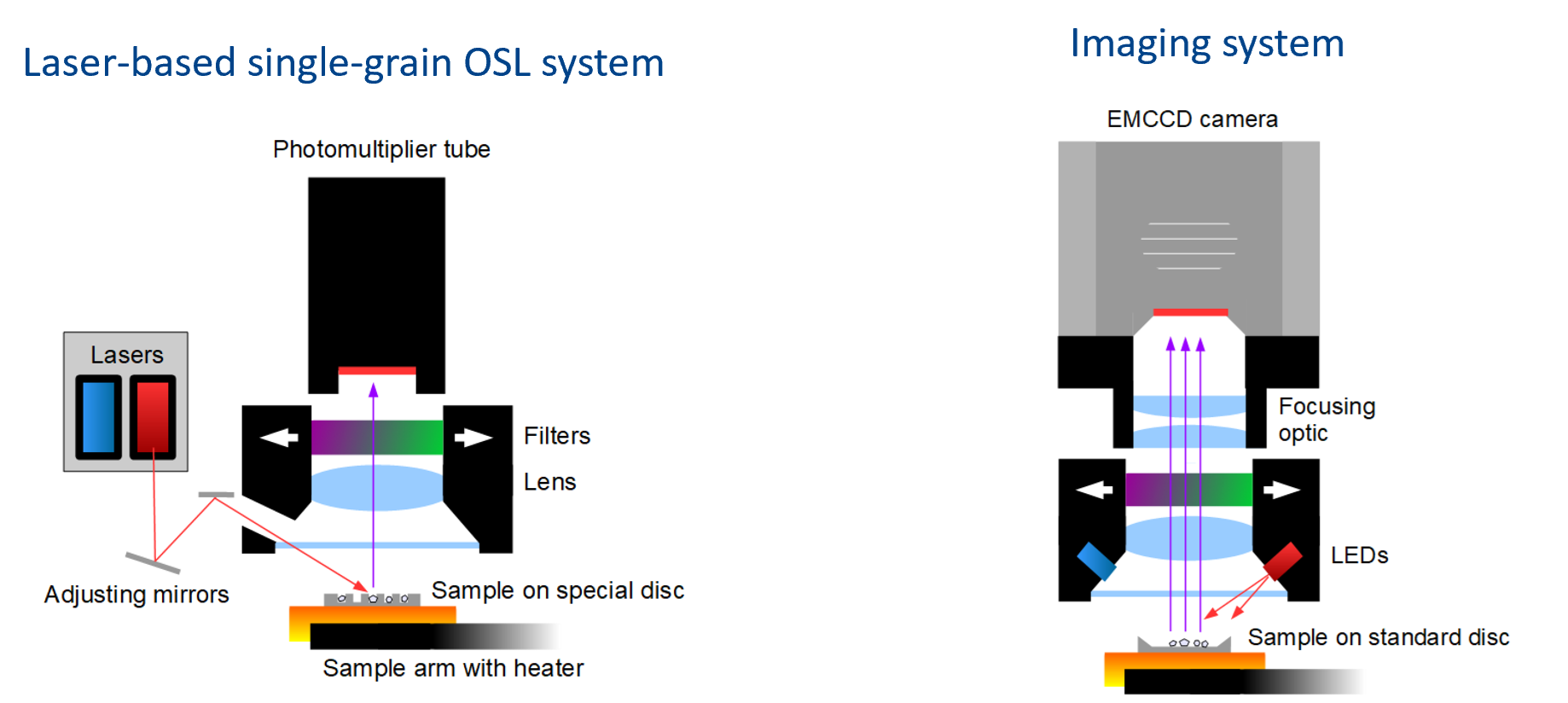
Currently, Laser-scanning is the default method in dating applications. But it is technical challenging and comes with a set of limitations: You need special sample discs and you are limited to optically stimulating this sample. There is no way to measure thermoluminescence or radioluminescence on a single-grain basis this way.
Luminescence imaging at the other hand, allows you to use all the kinds of stimulation you could also use at photomultiplier measurements. The idea goes back to the 1980s (Huntley and Kirkey 1985) and has been explored ever since, with the first commercial systems appearing in 2012 and 2015 (Richter et al. 2013; Kook et al. 2015). Still, the number of actual dating applications remains surprisingly small. But why was luminescence imaging never widely adopted in Geochronology?
The cross-talk problem
One reason for the slow adoption is that imaging luminescence signals is genuinely tricky. The main culprit is signal cross-talk: light from bright grains scatters into neighbouring pixels and contaminates their signal (Gribenski et al. 2015). The most used luminescence effect in dating is the optically stimulated luminescence (OSL) emission at 365 nm of quartz. However, most quartz grains emit only very few photons of this signal. You need maximum signal yield, that pushes you towards using optics with large numerical aperture and high UV-transmission but strong aberrations — a frustrating trade-off between image quality and signal strength.
Our solution: switch to IR-RF
Instead of fighting the physics of blue-light OSL, we switched to infrared radiofluorescence (IR-RF) of K-feldspars at 880 nm (Erfurt 2003; Frouin et al. 2017). Here, signals are much brighter and you have a lot of time to acquire as much signal as needed. Thus, maximum-signal-yield optics are not needed and signal cross-talk is much reduced.
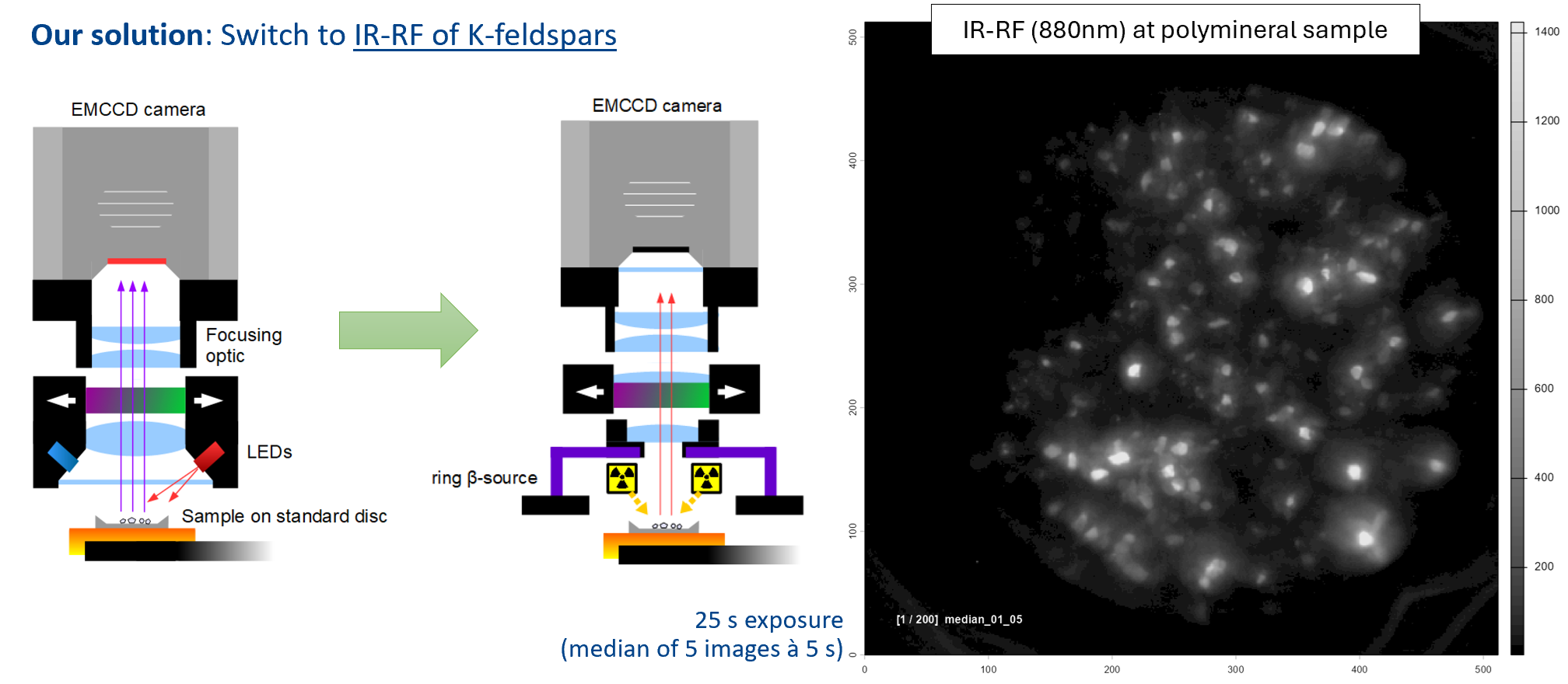
Spatially resolved IR-RF dating of single feldspar grains was first sketched out twenty years ago (Krbetschek and Degering 2005), but it’s only now getting proper traction. We published the first systematic approach in 2021 (Mittelstraß and Kreutzer 2021) and a team of experts in Oxford verified and improved our approach recently (Kumar et al. 2026).
Beyond dating: multispectral RF
Our work in DFG project ARENICOLA is now the next step forward. The most exciting part is moving from single-band to 6-band multispectral RF imaging. By measuring radiofluorescence at six different emission bands in short sequence, each grain produces a spectral fingerprint. This lets us:
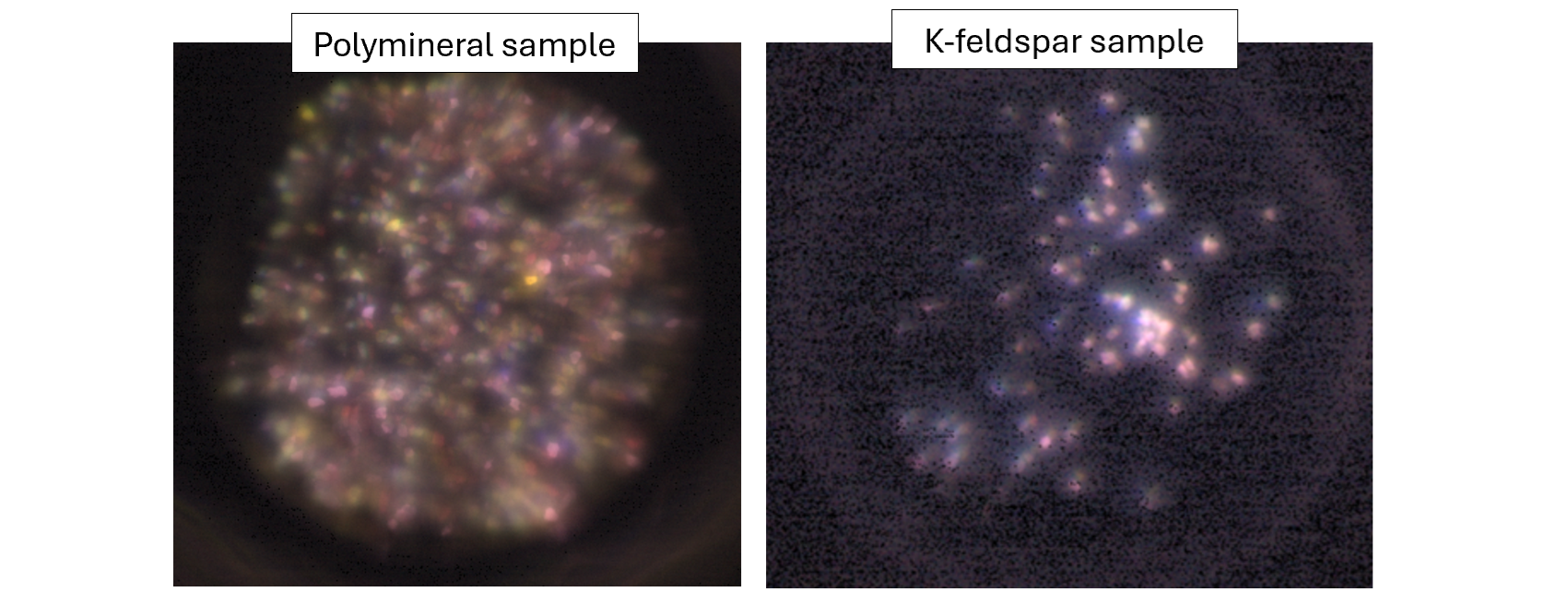
- select only the right minerals — K-feldspars stand out clearly from the rest of a poly-mineral mixture because of their strong emissions in the NIR.
- simplify sample preparation — selecting K-feldspars optically means no requirement for mineral separation in a wet-lab.
- get a new handle on sediment provenance — grain statistics at multiple wavelength bands allow to empirically compare samples from different origin or different grade of weathering.
References
© Dirk Mittelstraß, 2020 - 2026 | This website was created with Rmarkdown